
If the words "new-patient exam" make you picture a clipboard, a bright light, and a mystery bill, you are not alone. Many people put off finding a dental home because they are not sure what actually happens at that first visit. This post walks you through a first appointment with a family dentist near me, step by step, so the unknown turns into a simple plan.
You will follow the visit from before you arrive, including forms, health history, what to bring, check-in, and the intake conversation. Then we will cover digital X-rays, gum measurements explained without jargon, the cleaning itself, and the dentist's examination. You will also learn how to hear your findings in plain language, talk through a treatment plan, and understand cost, insurance, and the six-month rule. If it has been years since you saw a dentist, or you feel nervous, that is welcome here too. We will finish with the new-patient questions we hear most. By the end, you should know what each step is for, what it is not, and what, if anything, comes next.
Why a First Visit Is a Baseline Record, Not a Sales Pitch
When you search for a "family dentist near me," the real question is usually simpler: what actually happens once I sit down in the chair, and will I be pressured into treatment I do not need?
Your first appointment is a comprehensive oral evaluation, the code dentists call D0150. In plain terms, it is a full picture of your mouth today that every future visit gets compared against. That baseline records your medical and dental history, an oral cancer check, hard and soft tissue findings, bite relationships, existing fillings, crowns, and bridges, and a periodontal screening.
Here is the honest part: a baseline exam may find nothing at all, or it may flag something worth watching. Both are successful visits.
A thorough exam at a family dentist office is diagnostic, not promotional. You should leave knowing what is healthy, what needs attention, and what your options are, with no obligation to schedule anything that day.
Naamans Dental is a family practice in Wilmington, Delaware, serving North Wilmington, Brandywine Hundred, and nearby southeastern Pennsylvania communities. Learn more about our Wilmington dental office.
Before You Arrive: Forms, History, and What to Bring
Preparing ahead makes the appointment smoother. Your intake form asks about your medical history because your mouth is not separate from your health. Certain health conditions -- including systemic ones your doctor manages -- can influence how dental care is approached, which is why a thorough medical history matters.
Bring a current medication list, including over-the-counter drugs, vitamins, and supplements. Some medications affect bleeding or saliva production, so mention everything you take -- prescription and over-the-counter -- and never stop a medication before asking your physician.
Bring your dental insurance card, photo ID, and your previous dentist's name if you would like records transferred. Earlier X-rays can save time and money.
Jot down your two or three biggest concerns: sensitivity, a chipped tooth, bleeding gums, jaw clicking, or bad breath. If you feel nervous, note it on the form so the team can plan accordingly. Questions before you arrive? Visit our contact page.
Step One: Check-In and the Intake Conversation
Once your forms are in, the front desk confirms your information, verifies benefits, and answers cost questions before anything begins. It is the most ordinary part of the visit and often the most important.
A hygienist or assistant then walks through your health history in person, not just on paper. Add anything the form missed, like a recent surgery or a medication change.
Expect a short talk about your goals: is something hurting, do you want a routine dental exam, or has it been years?
Finally, say how you like information delivered: every detail as we go, or a summary at the end. Tell us which, and the visit is shaped around you.
Ask your own questions here: how long this takes, what comes first, what might be uncomfortable, what it costs. No question is wrong.
Haven't scheduled your first visit yet? You can request an appointment online.
Step Two: Digital X-Rays and Why They Come Before the Cleaning
Once your history and goals are covered, images usually come before the cleaning so your dentist is not examining blind. Decay between teeth, bone loss, root-tip infection, and impacted wisdom teeth often show up on X-rays long before they hurt.
Common images: bitewings for back teeth where most cavities start, periapical films showing one tooth root to tip, and a panoramic image of your full jaw, sinuses, and wisdom teeth.
Digital sensors have replaced film in most practices. They deliver very low radiation exposure, appear on screen in seconds, and enlarge so you can see what your dentist sees. The ADA notes timing depends on oral health, age, and risk, not habit.
New patients need a fuller set because there is no prior record. Returning patients usually need fewer, based on risk. Tell the team if you are or might be pregnant, or if you had recent imaging. X-rays can be deferred or adjusted. Recommendations depend on your exam.
Step Three: Gum Measurements, Explained Without Jargon
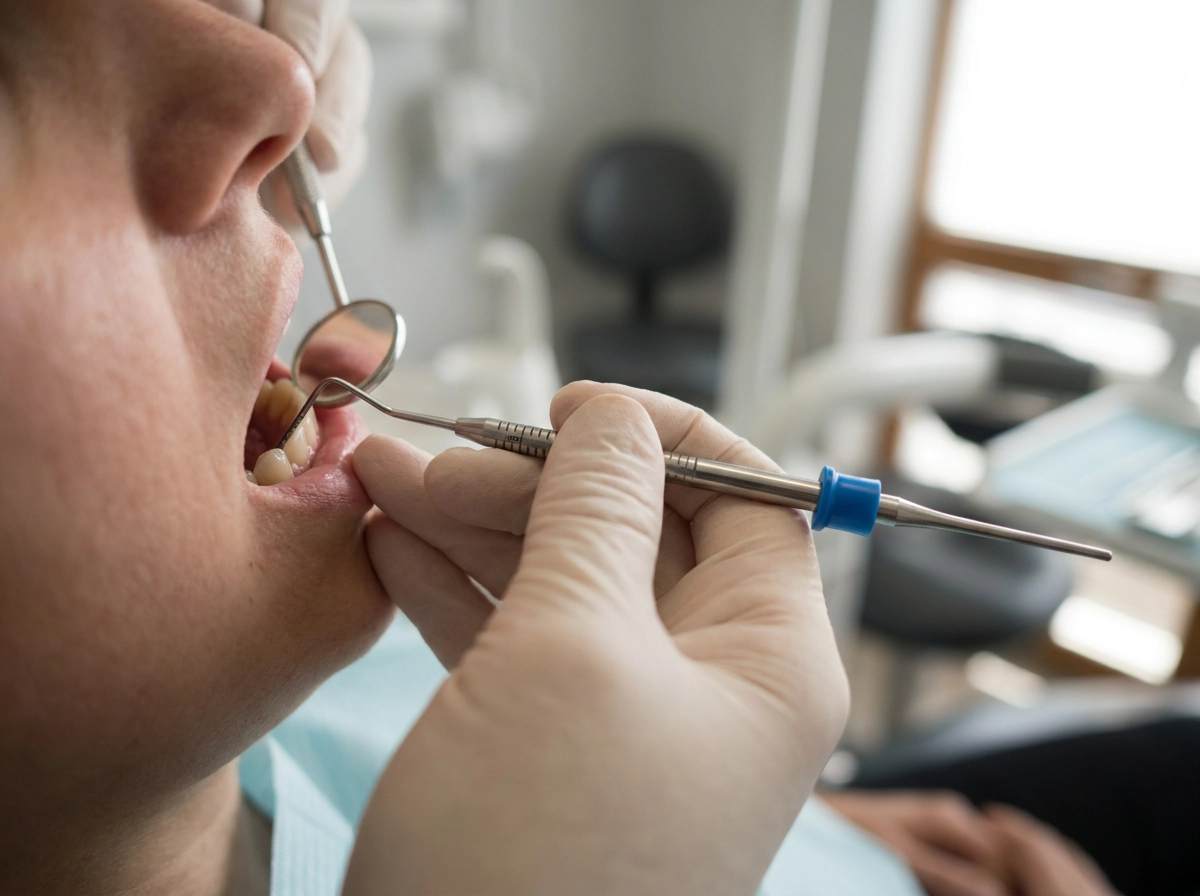
Next comes the step people worry about most. Periodontal probing is just measuring. A thin, blunt instrument slides gently between each tooth and gum, and the pocket depth is read aloud. One to three millimeters is generally healthy. Four millimeters and deeper can indicate inflammation or early gum disease that warrants closer attention. Bleeding on gentle probing matters as much as the number. Healthy gums should not bleed, so a bleeding spot shows your clinician where inflammation is active, even if you feel nothing. A full charting records readings at several points around every tooth, so changes can be tracked over time. If you smoke or have diabetes, a comprehensive periodontal evaluation may be the appropriate exam rather than a standard screening. For most healthy adults this is quick and mildly ticklish. Deeper readings after time away are common, not a judgment. They are your starting point.
Step Four: The Cleaning Itself
With your gum chart in hand, the hygienist begins the cleaning, or prophylaxis. It removes what brushing cannot: soft plaque, hardened tartar above the gumline, and staining from coffee, tea, or tobacco. Polishing with a soft rubber cup and gritty paste smooths surfaces, and some practices offer a fluoride treatment as a preventive step; ask whether it is part of your appointment.
If it has been years, expect more time and possibly a split cleaning over two visits. Heavy tartar often needs it, and numbing can keep you comfortable. Parents searching for teeth cleaning near me should ask how a practice introduces young children to the chair.
Step Five: The Dentist's Examination
Once your cleaning is done, the dentist takes over. They review your X-rays and gum chart, then examine each tooth and restoration for cracks, wear, decay, or loose margins.
An oral cancer screening is part of every exam. The dentist visually inspects oral tissues for anything unusual. Early detection of oral changes is one of the important reasons the exam covers soft tissue as well as teeth.
Soft tissue, bite, and jaw joints get checked too. Clenching, grinding, a shifting bite, or clicking can explain headaches, worn teeth, or sensitivity with no cavity behind it.
Existing work is inventoried: fillings, crowns, bridges, implants, and dentures are noted along with their condition, so future visits have a comparison point. Intraoral photos are often taken for the same reason.
Here, an unimportant finding stays unimportant. Not every groove or stain needs treatment, and an honest exam says so.
Step Six: Hearing Your Findings in Plain Language
After the exam, the dentist should translate everything into plain language.
Findings usually fall into three buckets: what looks healthy, what is worth watching, and what needs treatment now. That sorting keeps an exam from feeling like a shopping list.
Ask to see what's being described. Most practices can pull the X-ray or intraoral photo onto a screen and point to the exact spot, so an abstract number becomes something you can see.
Categories carry different urgency. A cavity, gum inflammation, a cracked filling, and a missing tooth aren't the same problem, and a watch item is genuinely different from a treat-now item.
Worth asking:
Is this active or stable?
What happens if we wait six months?
How long has it likely been there?
What would you do if this were your mouth?
You can ask for a written summary to review at home.
The Treatment-Plan Conversation and What You Owe
What the Plan Actually Is
That written summary is your treatment plan: what's recommended, why, the order, and roughly what each item costs. It's a document to take home. You don't owe a decision in the chair.
Options Are Supposed to Be Options
A small cavity might be watched, filled, or managed with a fluoride plan, depending on your risk. A failing tooth might be repaired with a filling, rebuilt with a crown, or, in some cases, removed and replaced. Ask about the trade-offs of each path.
Sequencing, Not Speed
If several things need doing, there's usually a sensible order: pain or infection first, then the rest spread over time.
What You Owe, and What You Don't
You can decline, delay, or get a second opinion. A practice confident in its recommendations welcomes that.
Ask how much is urgent versus optional, what can safely wait, and whether a less expensive approach exists. This conversation is where a dental family relationship begins.
Cost, Insurance, and the Six-Month Rule
Most dental plans cover one evaluation every six months, or two in any twelve-month period, and some track that limit to the day. Know your plan's frequency rules before scheduling a re-exam.
Exam types exist for clinical reasons. A periodic evaluation checks established patients for changes since the last visit. A comprehensive evaluation fits new patients, or anyone away from active treatment three or more years. A comprehensive periodontal evaluation applies when signs, symptoms, or risk factors for gum disease are present.
Treatment codes follow clinical definitions, not what your plan reimburses. Recommendations should reflect what's in your mouth; insurance gets sorted out afterward.
Ask for a written estimate before treatment begins, and whether a larger plan can be staged to fit your budget. Financing terms vary, so confirm them directly. Our dental services page can help you plan ahead.
Be wary of any office that won't explain why treatment is recommended. Clinical need should stand on its own.
Coming Back After Years Away, or If You Feel Nervous
If it has been years since your last visit, that is okay. You will not get a lecture. We start where your mouth is today and build the plan from there.
After a long gap, expect a fuller baseline: a comprehensive exam with X-rays and a gum chart, since there is no recent record to compare against. Gum disease is a common finding after a long gap in care, and early stages can be managed. If you notice bleeding when you brush, persistent bad breath, or changes in your gums, those are signs worth discussing with a dentist sooner rather than later.
If a tooth hurts, is broken, or looks infected, say so when you call. Calling early means simpler treatment.
Feeling nervous is normal -- let us know and we will slow down, explain each step, and agree on a pause signal.
New-Patient Questions We Hear Most
A few practical questions remain.
How long does the first visit take? Depends on imaging and how long since your last cleaning. Ask when you book for a realistic window.
Will the cleaning hurt? Routine cleanings are usually comfortable; sensitivity is more likely with inflamed gums or heavy buildup -- say something early if you want slower pacing or numbing.
Will I be told I need a lot of work? Sometimes an exam finds real needs, sometimes nothing. Both are normal. Every recommendation is explained and shown on screen.
When should a child first see a dentist? Many dentists suggest around the first teeth or by age one. That visit is short and friendly, mostly counting teeth.
Can the whole family be seen together? We try to coordinate family appointments, though availability varies, so ask when you call. Naamans Dental welcomes children, adults, and seniors from North Wilmington, Brandywine Hundred, and nearby Pennsylvania communities. About our practice or call 302-475-3743.
Conclusion
That baseline exam gives every future visit a point of comparison. Digital X-rays, gum measurements, a gentle cleaning, and a clear exam work together to show what is healthy and what needs attention. You should leave understanding your findings, your options, and your costs in plain language, with no pressure.
For pain, swelling, or a broken tooth, call early so treatment stays simpler. Ready to start? Schedule your first visit with Naamans Dental by calling 302-475-3743. Your healthiest smile can begin with one small, brave step today.