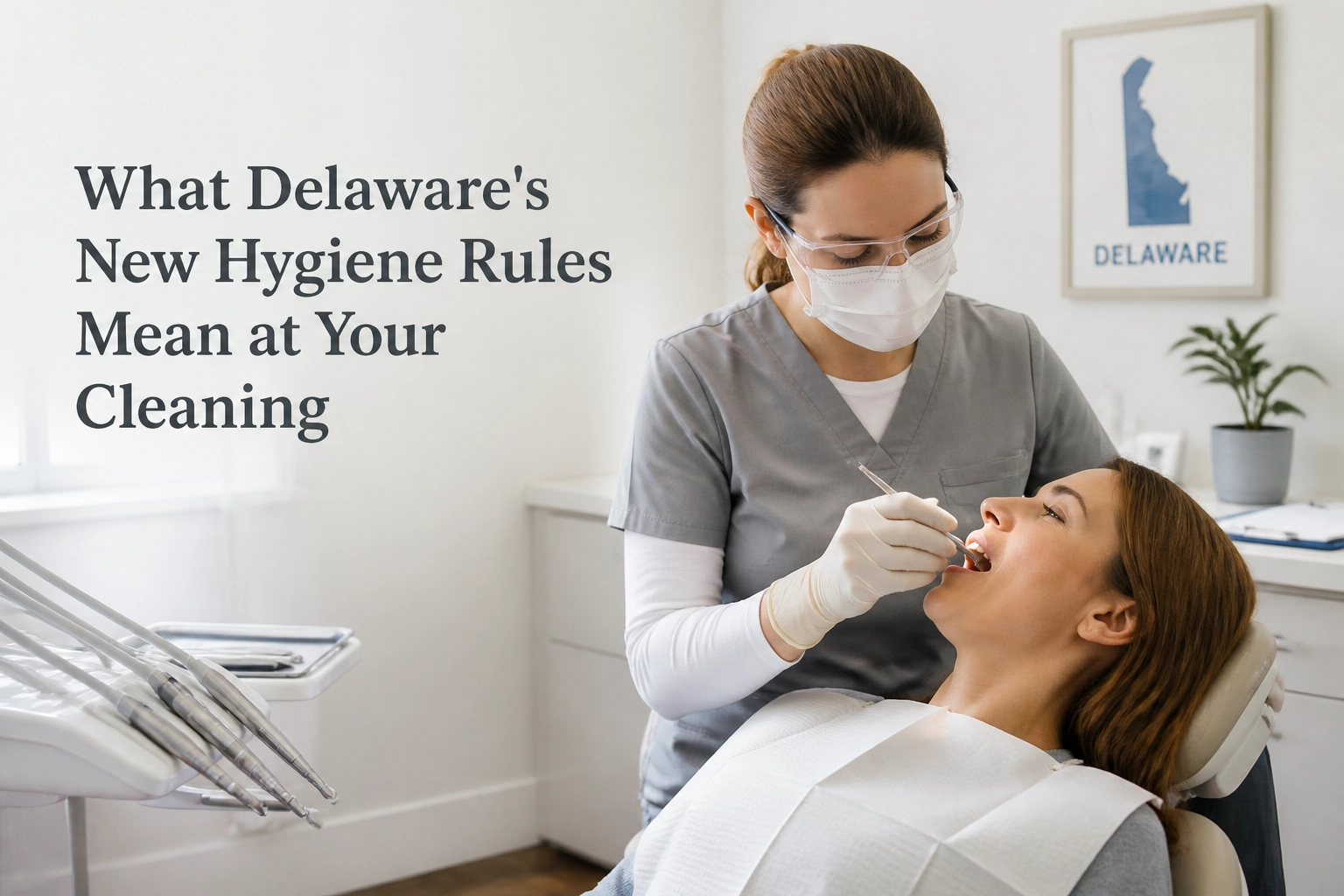
You know the rhythm of a routine dental visit: check in, settle into the chair, and see the familiar faces who handle your care. A recent scope-of-practice change in Delaware means the dental hygienist you already see can take on more of the preventive work during your appointment, from your assessment and gum measurements to the cleaning itself and certain preventive services. Diagnosis and treatment planning still stay with the dentist.
This article explains what that shift means for your actual appointment, not the legislation behind it. We will walk through what changed and when it takes effect, what direct and general supervision mean in plain English, and what still belongs to the dentist. You will also see what a routine teeth cleaning visit now involves, what was already normal, and the questions worth asking at your next recall visit. If you are in Brandywine Hundred or anywhere near North Wilmington, knowing who does what helps you get the most from every cleaning. Let's start with the headline and what it means in the chair.
The Delaware Headline and What It Means at Your Cleaning
If you saw a headline about Delaware dental hygienists gaining new duties and already have a teeth cleaning on the calendar, the practical question is simple: is your appointment different? The one confirmed change is narrow. Delaware now permits dental hygienists to administer local anesthesia under the direct supervision of a licensed dentist. The permit requirement took effect January 1, 2026; written public comment ran through January 7, 2026; and the Board of Dentistry and Dental Hygiene met January 15, 2026 to consider those comments.
That is a regulatory update, not a new office policy. What a dental hygienist at any individual practice can do depends on state permits and that practice's own protocols, so ask at your visit. This piece is education, not an announcement of our office's policy. It explains who does what at a routine visit, what still stays with the dentist, and what to ask at your next teeth cleaning. For appointment basics, see our preventive care and cleaning page.
What Actually Changed in Delaware, and When
The mechanics sit in a new section 14.0 from the Delaware Board of Dentistry and Dental Hygiene, which sets the requirements and standards for permits authorizing dental hygienists to administer local anesthesia under a dentist's direct supervision. The full text is available in the Delaware Register proposed regulation.
The dates are straightforward. The local anesthesia permit takes effect January 1, 2026. Written public comment was due January 7, 2026, and the Board met January 15, 2026 to review the comments it received. A scheduled public hearing was cancelled for lack of quorum, so input moved through written comment instead. That procedural detail helps explain why most patients saw little coverage of the specifics.
Other moving parts were folded into the legislation enacted in 2025, including revised delegation rules for auxiliary personnel and the addition of certified registered nurse anesthetists to those who may administer anesthesia in an approved office.
Trade reporting has framed Delaware as the last state to permit this. Decisions in Dentistry ran that headline in September 2025, though the comparison is a reported claim rather than something independently verified here. For the state's licensing categories, including Dental Hygienist, Restricted Permit I and II, and Unrestricted Permit, see the Delaware Division of Professional Regulation dental board page. Those categories are what determine what a given hygienist may do.
Direct and General Supervision, in Plain English
Those supervision terms are where the practical difference sits. Direct supervision means the dentist is in the office, examines you personally, makes the diagnosis, specifically authorizes the work, and checks it before you leave. General supervision is broader: the dentist may or may not be in the office, but still authorizes the work. The supervision level that applies depends on the specific procedure and the practice's protocols.
At the chair, the difference tells you when the dentist is personally involved in a step and when the office's standing protocols and authorization guide it. That is about safety, accountability, and clear authorization, not a dentist stepping away from your care. Your own visit still depends on the individual examination and the practice's protocols. Next, it helps to separate what stays with the dentist from what the hygienist handles.
What Still Stays With the Dentist
If the hygienist gathers the information, who interprets it? The dentist does. Diagnosis and treatment planning stay with the dentist, which matches how Delaware defines direct supervision: the dentist is responsible for identifying the condition and authorizing the work. The dentist reviews the hygienist's findings, authorizes any procedures, and examines you before you leave, the steps that Delaware law reserves for a licensed dentist.
Then comes treatment planning. If something needs care, the dentist explains your options and why one path fits your situation better than another. That conversation is where sequencing happens: what to treat now, what can wait, and what to watch.
The handoff is simple. The hygienist gathers measurements and performs the preventive work, then the dentist reviews the findings with you and answers your questions, ideally before you leave. For a step-by-step look at how a first visit unfolds, see your new-patient exam and cleaning at a family dentist.
One honest note: recommendations depend on an individual examination. No article can tell you what your own teeth and gums need.
What a Routine Teeth Cleaning Visit Looks Like
With that division clear, here is how the preventive side of your visit typically unfolds.
It starts with a health history update: new medications, medical conditions, pregnancy, tobacco use, and any sensitivity, bleeding, or pain you have noticed.
Next, a small probe checks pocket depths around each tooth and notes bleeding or inflammation. Those numbers matter most as a trend across visits, not as a single set.
Digital X-rays are taken when they are due, with frequency based on your risk and history rather than a fixed rule for everyone. They help the dentist and hygienist see between teeth and below the gumline.
Then comes the cleaning itself: removing plaque and tartar above and below the gumline, polishing, and flossing, the part most people picture when they think of a teeth cleaning.
Depending on your examination and your dental office's protocols, your dentist or hygienist may discuss preventive options and home-care adjustments suited to your situation. If whitening is on your mind after your cleaning, an exam comes first, as explained in do whitening strips work as well as in-office whitening?. Our services page outlines the preventive care we offer. With that baseline, you can better tell what is routine and what the new rules may touch.
What Changed for You and What Was Already Normal
The routine visit described above is not a new schedule. In most practices, the assessment, gum measurements, cleaning, and many preventive services were already handled by a licensed dental hygienist working under the dentist's authorization. The one confirmed addition -- the local anesthesia permit effective January 1, 2026 -- is covered in the earlier section. As noted above, direct supervision requires the dentist to authorize the procedure and examine you before you leave.
Adoption will vary. Permit status differs by hygienist, and each practice sets its own protocols, so not every office will offer the same services on the same timeline. The practical rule is simple: do not assume a service is included in your visit. Ask, and expect an answer tied to your own examination. For background on how preventive care fits together, see our patient education resources.
Questions to Ask at Your Next Cleaning
Since permit status and office protocols vary, the most useful step is to ask directly. Try these questions at your next teeth cleaning:
Who is handling which parts of my visit today? A quick roadmap at the start prevents surprises when a dental hygienist takes on more preventive work.
Are my gum measurements changing compared with last time? Focus on the trend across visits. Small shifts over time are what lead to gum disease care.
Is there anything the dentist should look at before I leave? This keeps diagnosis and treatment planning with the dentist, where they belong.
Which preventive services am I due for, and why? Fluoride, sealants, and X-rays should come with a reason tied to your risk and history, not a routine default. If you are also weighing tooth replacement, our guide to choosing between a dental implant, bridge, or partial denture explains how each option affects neighboring teeth.
If I need local anesthesia, who will give it and how is it supervised? Ask this if a deeper cleaning or comfort concern comes up.
What should I do at home before my next visit?
Have more questions? Contact our team before your appointment.
Quick Answers About Dental Hygienists and Cleanings
Those questions give you a solid start. Here are quick answers to a few more that patients ask before a cleaning.
Do I still see the dentist? Yes. The dentist examines you and makes the diagnosis. Treatment planning stays with the dentist. Skipping the exam would skip the part of the visit that catches problems early.
Can a hygienist give me a numbing injection? In Delaware, yes -- under a permit and direct supervision. Whether your office offers it depends on the hygienist's permit and the practice's protocols.
Is a teeth cleaning by a hygienist safe? Dental hygienists are licensed professionals who work under state rules and practice protocols. The dentist remains accountable for your overall care.
Will this change what my insurance covers? Coverage depends on your specific plan. Check before treatment if cost is a concern, and ask our team about your options.
Will my visit take longer? Not necessarily. The change is about who may perform certain steps, not about adding steps to a standard preventive visit.
Your Next Step in North Wilmington
If it has been a while since your last teeth cleaning, or you want to know who does what during your visit at our family dentist office in Wilmington, DE, request an appointment at www.naamansdental.com or call 302-475-3743. You can also meet our team before you come in. Naamans Dental serves North Wilmington, Brandywine Hundred, and nearby southeastern Pennsylvania communities.
Conclusion
Delaware's confirmed 2026 update is narrower than the headlines suggest: hygienists may administer local anesthesia under direct supervision, while your dentist remains accountable for your overall care. Your routine cleaning still follows the same familiar steps, and the habits that protect your smile have not changed. Keep preventive visits on schedule, speak up about bleeding gums or sensitivity, and ask who does what at your next appointment. Understanding the rules helps you feel at ease in the chair and make confident, informed decisions about your care. If it has been a while since your last cleaning, or you would like to know how your visit will work at our family dentist office in Wilmington, DE, request an appointment at Naamans Dental online or call 302-475-3743. Your next healthy smile starts with one simple step.