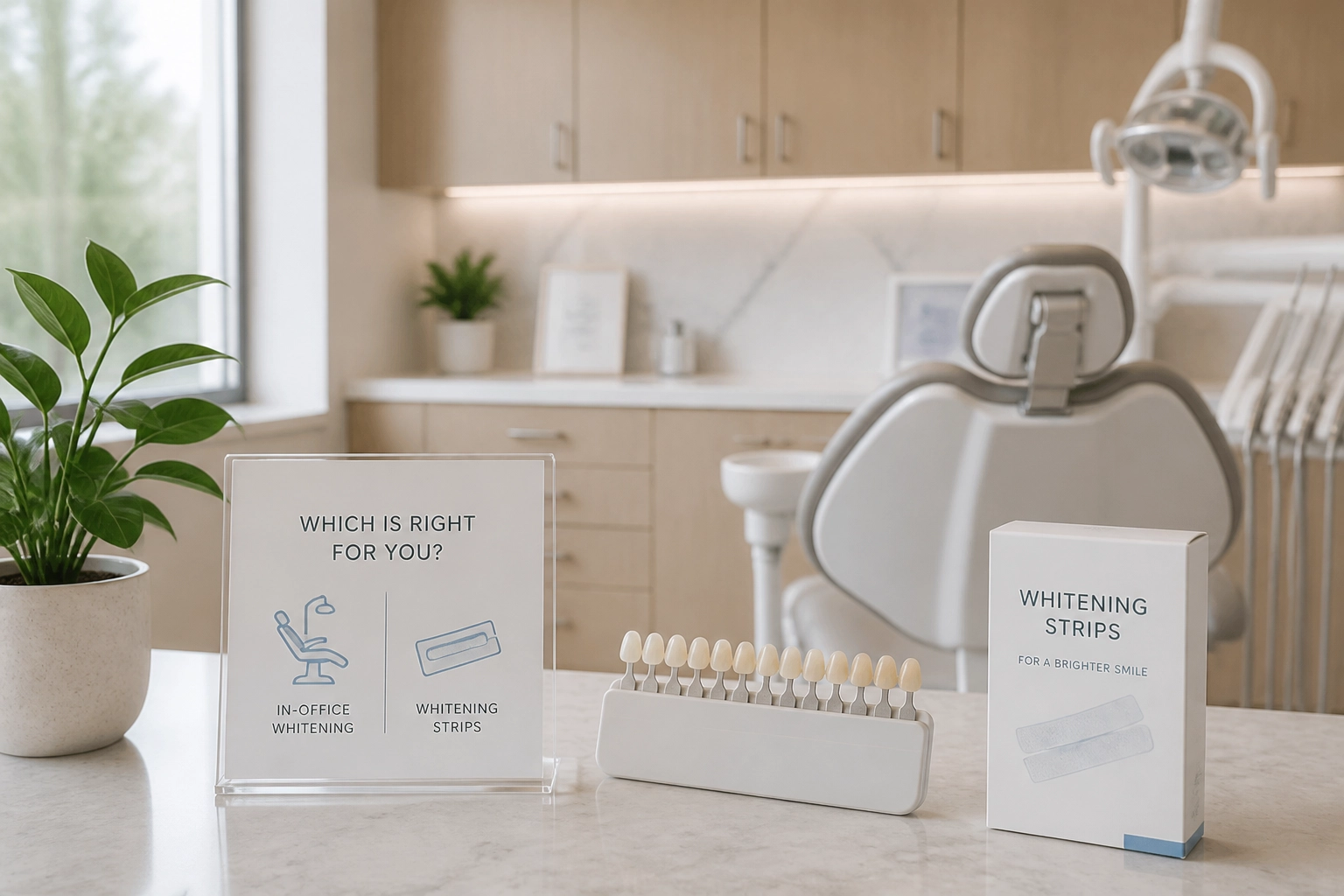
Thinking about brightening your smile before a Wilmington wedding, reunion, or just because? You might be staring at a box of whitening strips and wondering whether they can match what a dentist does in the chair. Here is the honest answer: strips and in-office whitening are not the same product at different prices. They target different kinds of stains and hold their results for different amounts of time.
Below, we will break down what actually causes yellow or dull teeth, what in-office whitening does best, and where store-bought strips fit. You will get a side-by-side look at shade change, duration, sensitivity, and upkeep cost. We will also cover when whitening will not change your shade, including bonding, veneers, and intrinsic stain. Before you spend anything, you will learn why an exam matters and how to find safe teeth whitening near me in North Wilmington. If you are ready to pick the right treatment the first time, keep reading.
What Actually Causes Yellow or Dull Teeth

Before you compare products or prices, it helps to know which kind of discoloration you are looking at. Discoloration is typically classified as extrinsic, intrinsic, or a mix of both, according to the American Dental Association.
Extrinsic stain sits on the outside of the enamel. Coffee, tea, red wine, cola, dark berries, tomato sauce, tobacco, and everyday plaque leave a film on the surface. This is the kind whitening handles best.
Intrinsic stain lives inside the tooth. Enamel thins with age, letting the yellower dentin underneath show through. Trauma, some childhood antibiotics, and certain medical conditions can also darken teeth from within. Products applied from the outside reach this layer with more difficulty.
The ADA notes whitening can be effective against both types, but how much your shade changes depends on the type and depth of the stain, not on how much you spend.
One more category: heavy plaque and tartar. Bleach will not remove deposits left behind by missed brushing. A professional cleaning, or treatment for active decay, may need to happen first.
Here is the point of this whole article: name the discoloration before you compare brands or prices. That single step tells you which option can actually change your shade.
In-Office Whitening: What It Does Best
So once you know what is causing your discoloration, here is where in-office whitening shines.
In-office whitening uses hydrogen peroxide or carbamide peroxide gel at a concentration far higher than anything sold on a shelf, applied by a dental professional during one visit. As a point of reference, European regulators cap consumer whitening products at 0.1% hydrogen peroxide, and products above that up to 6% are intended for dentist administration only (tooth whitening information sheet).
Your gums and lips are isolated and protected before the gel touches your teeth. That step matters, because the gel is strong enough to irritate soft tissue if it rests against it.
Supervision is the other half of the value. Your dentist can watch how your teeth respond, pause if sensitivity climbs, and confirm that no untreated cavities or worn restorations are sitting under the gel.
This option typically delivers the largest single-session shade change available, and much of it is visible right away. Some color keeps settling over the next few days as the whitening agent clears from your teeth.
Here is the misconception worth correcting: in-office whitening is not simply a stronger version of a strip. It reaches different kinds of stain, and it comes with clinical oversight a strip cannot provide. It suits patients with overall yellowing or food and tobacco stain who want a jump start, and it pairs well with dentist-supplied take-home trays for upkeep afterward.
Store-Bought Whitening Strips: Where They Fit
Strips sit at the other end of that spectrum, and they deserve a fair hearing. Each one holds a low-concentration peroxide gel against your front teeth for the time listed on the package, usually about 10 to 30 minutes a day for one to several weeks.
They do work. Whitening strips are effective rather than a placebo, and plenty of people with light surface stain on otherwise healthy teeth see a real difference.
The gap is oversight, not chemistry. Without a dentist checking first, gum irritation from gel contact or sensitivity from an untreated cavity can go unnoticed until it becomes painful. That is why a clinical examination is recommended before whitening, even with a product you can buy off the shelf.
Consistency drives the result. Skipping days or cutting strip time short reduces the shade change you end up with, so the cheapest box on the shelf may not deliver the outcome you pictured.
Mouthwashes marketed for whitening are the weakest option in this category. A dentist interviewed by Boston University described them as unlikely to whiten effectively, with only a possible modest effect from repeated daily rinsing over two to three months.
What strips cannot do matters just as much. They do not lighten bonding, veneers, or crowns, they struggle with gray or intrinsic tones, and their results fade with normal eating, drinking, and smoking habits.
Side-by-Side: Shade Change, Duration, Sensitivity, and Upkeep Cost
So how do they stack up head to head?
Shade change. In-office whitening usually delivers the bigger single-visit jump; strips tend to produce a smaller, gradual shift over weeks. Neither can be promised in advance. Your starting shade and the cause of the stain decide the outcome.
What each targets. Both work on natural enamel. In-office gel reaches deeper, more stubborn stain. Strips do best with light surface discoloration on healthy teeth.
Sensitivity. The ADA lists temporary tooth sensitivity and gingival inflammation as the most common adverse effects of whitening teeth, and both options carry that risk. In-office is monitored, so gel can be paused or adjusted during the appointment.
How long results last. Shade holds for months, not permanently. Diet, tobacco, oral hygiene, and whether you maintain with take-home trays or periodic touch-ups all affect how fast it fades. Research on whitening persistence is ongoing, and individual variation is wide.
Upkeep cost. A box of strips is the smaller single purchase. Professional whitening is a larger upfront investment that often includes take-home maintenance. Compare cost per year of maintained shade, not cost per box. An office visit can also include an exam and cleaning in the same trip.
We will not print a price table. Fees, the number of visits needed, and how long your result lasts depend on your examination. Any office quoting a guaranteed shade or guaranteed lifespan is promising something no one can control.
When Whitening Will Not Change Your Shade
Here is where the honest part starts. Whitening gel only lightens natural tooth structure. The ADA is clear that tooth-colored restorations do not respond: bonding, composite fillings, porcelain veneers, and crowns stay the shade they were made in while the enamel around them gets lighter. That mismatch can be more noticeable than the original color. Realistic fixes are replacing the restoration in a brighter shade, or whitening first and matching new restorations to the lighter result.
Some intrinsic stain also resists whitening, including tetracycline-related color and discoloration that follows trauma. Bonding, veneers, or a crown may serve you better, but only an exam tells you which.
Two conditions have to be handled before whitening of any kind. Heavy deposits and active decay need treatment first, and gel reaching a cavity can cause severe pain. A single dark tooth may signal a nerve problem rather than surface stain, which means it needs a diagnosis, not a strip. A dentist can also bleach a non-vital tooth from the inside in certain cases, something no store-bought product can do.
If you are weighing porcelain veneers, bonding, or whitening, the answer depends on your enamel, your gum health, and the shade you want to reach. An examination settles it, and it is also the step that protects your budget. That brings us to why we recommend one before you buy anything.
Have an Exam Before You Spend Anything
Whatever your teeth are showing, one step protects both your wallet and your comfort: a dental exam and cleaning before you whiten anything, whether that's a strip from the drugstore or a professional treatment.
An examination finds what a whitening product cannot see. Cavities, worn or leaking fillings, exposed roots, gum inflammation, and existing restorations all show up on that visit, and any one of them can change which option makes sense for you.
A professional cleaning matters just as much. It removes surface deposits and tartar that no whitening gel can lift, and starting from a clean surface often helps whitening look better and hold longer.
Come with two questions. First, ask about your enamel thickness and gum health. Thin enamel or receding gums can raise the odds of sensitivity with either option. Second, ask how sensitivity is managed before you begin. Temporary tooth sensitivity and gum irritation are the most common complaints linked to whitening, and an office can take preventive steps in advance.
If it has been years since your last visit, that is genuinely fine. There is no lecture waiting for you, and returning patients are welcome here.
An exam is not a hurdle between you and a brighter smile. It is the step that keeps you from spending twice.
Choosing a Teeth Whitening Office Near You in North Wilmington
If you have decided an exam comes first, the next step is finding the right place to have it. Naamans Dental is a family dental practice at 2018 Naamans Road, Suite 2, Wilmington, DE 19810, serving North Wilmington, Brandywine Hundred, and nearby southeastern Pennsylvania communities. Because we offer both in-office whitening and take-home options, the recommendation can follow your teeth rather than a product list. You can learn more about our practice before you call.
Questions worth asking any office: do they examine and clean first, do they offer both in-office and at-home whitening, how do they handle sensitivity, and what does upkeep cost over a year? Ask whether the shade you are picturing is realistic for your enamel and your type of stain. A good answer to that question tells you more about an office than its price sheet does.
If strips are a reasonable fit for your situation, we will say so plainly instead of upselling you. If they are not, we will explain why and what would work better.
Look for a dentist in North Wilmington who treats whitening as one part of your overall dental health, not a standalone purchase. Cavity prevention, gum health, and your existing restorations all shape how whitening turns out.
New patients, families looking for a long-term dental home, and anyone returning after time away are all welcome to schedule a visit and talk through options.
Your Next Step Toward a Brighter Smile
Strips and in-office whitening are not the same product at different prices. They lift different kinds of stain, fade at different rates, and happen under very different levels of supervision. That is why the fastest way to stop guessing is an examination. It confirms what is actually causing your discoloration, whether whitening can change it, and which option suits your teeth, your comfort, and your budget.
Ready to find out? Request an appointment at www.naamansdental.com or call 302-475-3743. We will explain your choices clearly, answer your questions, and let you decide without pressure. Whichever route fits, you will know it is the right one for your smile.
Conclusion
Whitening strips and in-office whitening are not interchangeable. They lift different stains, produce different shade changes, and involve different levels of sensitivity and supervision. Strips can help mild surface discoloration, while professional whitening offers more control, stronger results, and oversight for your enamel, gums, and restorations. Before buying anything, an exam identifies what is causing the discoloration and whether whitening can realistically change it. That guidance protects your time, money, and smile.
Ready for clear answers without pressure? Schedule a visit at naamansdental.com or call 302-475-3743. We will explain your choices, answer your questions, and help you decide with confidence. A brighter smile starts with one simple step: book your appointment today.