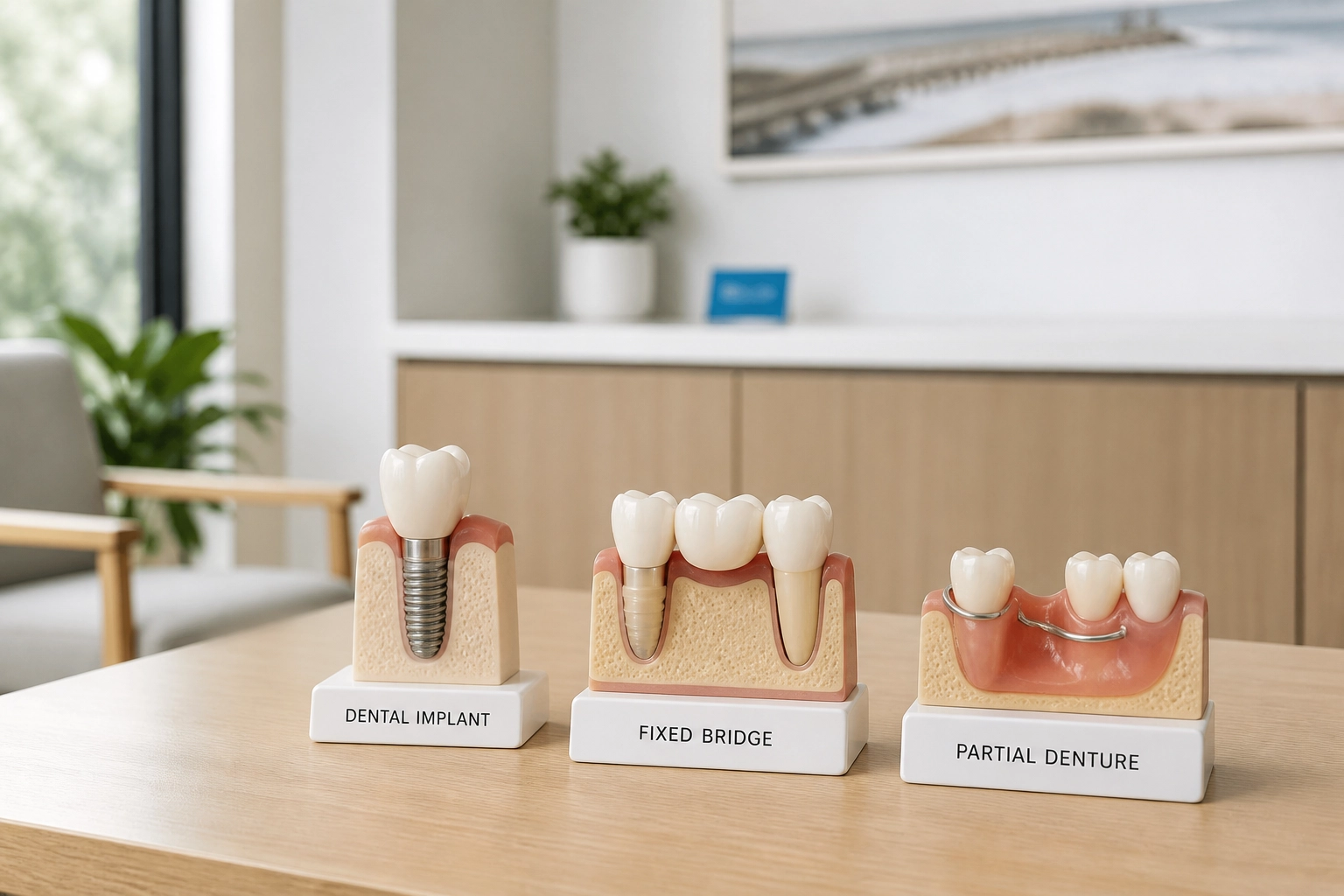
Losing a single tooth can feel like a small gap with a big question mark. You might wonder whether to replace it at all, and if so, how. For one missing tooth, dental implants vs bridge vs partial denture is not a contest with one obvious champion. It is a trade-off between how much time you want to spend in treatment, what you can budget now and later, how healthy your neighboring teeth are, and how long you hope the replacement will last.
In this post, we will walk through three ways to fill the same space: a dental implant with a crown, a fixed dental bridge, and a removable partial denture. You will learn how treatment time and visits compare, what costs look like up front and over the years, how each option affects the teeth next to the gap, and how longevity and maintenance differ. Then we will give you a simple decision framework based on your own constraints, plus questions to ask before you choose. By the end, you should feel ready to discuss dental implants vs bridge and partial dentures with a Wilmington dentist clearly and confidently.
Why One Missing Tooth Deserves a Thoughtful Decision
A gap from one missing tooth is rarely just a cosmetic issue. Neighboring teeth can tilt into the empty space, the opposing tooth can drift downward, and your bite can shift as chewing forces redistribute.
The jawbone beneath the gap also responds to the loss of stimulation over time, one reason dentists often recommend replacing a tooth sooner rather than later.
Patients describe the day-to-day effects more than the mechanics: chewing on one side, food catching in the gap, small speech changes, and feeling self-conscious when smiling.
Replacing a tooth is not one procedure but a family of three options: a dental implant with a crown, a fixed dental bridge, and a removable partial denture. None wins universally. The right fit depends on the health of the teeth beside the gap, your budget, how quickly you want a result, and how long you hope it lasts.
This guide compares all three fairly, so you can ask informed questions at a consultation instead of accepting whichever option is quoted first. Nothing here replaces an exam: your dentist confirms what is happening with X-rays and a hands-on look.
Three Ways to Fill the Same Gap
A dental implant with a crown replaces the tooth root with a small titanium post, then tops it with a custom crown. It stands alone and does not rely on neighboring teeth.
A fixed bridge, often just called a dental bridge, anchors to the teeth on either side of the gap and suspends an artificial tooth, called a pontic, between them.
A removable partial denture is a lightweight appliance with clasps or rests that fills the gap. You take it out to clean it and usually at night.
All three close the space and restore chewing. They differ in how they attach, what they ask of your other teeth, treatment time, up-front and long-term cost, and daily maintenance.
Implant-supported dentures are an option when many teeth are missing. For one missing tooth, this article covers the three choices above.
Option 1: A Dental Implant With a Crown
An implant replaces the root, not just the visible tooth. After numbing the area, your dentist places a small post into the jawbone. It heals and fuses with bone, then an abutment connects it to a custom crown. In plain terms, dental implants and crowns work together here.
Treatment is staged, with healing between visits. Bone quality and healing shape the schedule, so your dentist gives a realistic estimate after imaging, not a fixed number.
Because it stands alone, healthy neighboring teeth usually stay untouched, with no reshaping or crowning to support it.
Care is familiar: brush and floss it like a natural tooth, plus routine checkups. Many patients say it feels and functions like their own.
It does involve surgery and a longer overall window, and bone volume, gum health, or medical conditions can affect whether it fits you.
Option 2: A Fixed Dental Bridge
If the teeth beside your gap already have crowns, a fixed bridge is a practical alternative to an implant. A bridge adds crowns to those anchor teeth and suspends a false tooth, called a pontic, between them. It is cemented in place, so it does not come out. With no bone healing period, many bridges are finished in a few appointments.
The trade-off: anchor teeth are usually reshaped to hold crowns, a big factor if they are healthy and never treated. Long-span bridges can place extra load on those abutment teeth, which may lead to fractures or periodontal problems (retrospective study on tooth-supported bridges).
Cleaning takes extra care: floss threaders, interdental brushes, or a water flosser keep the area under the pontic clean. Decay or gum trouble under a bridge often leads to replacement, and if an anchor fails, the bridge may need remaking.
Option 3: A Removable Partial Denture
A removable partial denture asks the least of your neighboring teeth. It is a lightweight appliance with clasps or rests that grip nearby teeth, and sometimes precision attachments, to fill the gap. Because there is no surgery and no reshaping of anchor teeth, it is usually the quickest and least expensive path up front.
Clasps can still wear on or collect plaque around the teeth they rest against, and the fit needs periodic adjustment. You take it out daily for cleaning, usually overnight as well, and regular dental visits keep it comfortable as your mouth changes.
Some patients adapt easily. Others find it bulky or notice it shifting when they chew or speak, and relining or replacement is expected eventually. Whether those trade-offs suit you depends on your priorities.
Four Trade-Offs That Actually Decide It
Now that you've seen how each option works, here's the honest part. Cost, treatment time, the health of your other teeth, and how long you want the replacement to last surface in nearly every conversation about a tooth implant versus a dental bridge.
No single option wins on all four. The fastest choice may cost more over time, and the one that's gentlest on neighboring teeth may take longer to finish. So the next four sections don't crown a winner. They show where each option gives and where it takes.
Come with your own constraints in mind: budget range, work or travel schedule, comfort with surgery, and the condition of the teeth beside the gap. Everything here still needs confirmation through an exam and X-rays, because bone, gum health, and bite vary from person to person.
Treatment Time and Number of Visits
Timing is where these options differ most. An implant is usually staged: the post goes in first, then bone heals before your final crown is attached. That healing window varies with your bone and how you heal, so treat any timeline as an estimate.
A bridge often finishes in fewer visits because there is no healing period, which appeals when you want the gap filled quickly. A partial denture is frequently the fastest finished appliance, made from impressions with no surgery.
Ask two questions: how many weeks or months from first visit to the completed tooth, and can a temporary cover the gap while you wait? If a wedding, work event, or photos are coming, say so early so your dentist can plan around it.
Cost, Up Front and Over the Years
If timing is settled, cost is usually the next question. Up front, a partial denture is typically the least expensive, a bridge costs more, and an implant is often the highest single treatment cost.
Think past the first invoice, though. Relining, repairs, and eventual replacement can change the math for partials and bridges, while an implant's surgical step carries its own costs. Dental insurance may cover part of a replacement tooth and often caps benefits with an annual maximum, so coverage varies by procedure. Ask our team to check your benefits before you decide.
If budget is the deciding factor, ask about payment options and phased treatment; some patients sequence care over months. Just don't choose on price alone. Reshaping healthy teeth for a bridge and undergoing implant surgery each have consequences that outlast the invoice.
Impact on Your Neighboring Teeth
Cost is one way to compare these three; the health of the teeth beside your gap is another, and it separates dental implants vs bridge most clearly. An implant stands alone. A bridge borrows support from its neighbors, which usually means reshaping them into anchors.
If those teeth are healthy and unfilled, many dentists hesitate to grind them down. If they already need crowns, a bridge can solve two problems at once, and that is a fair reason your dentist may suggest one.
A partial denture asks the least of your neighbors, though clasps rest against them. Without daily cleaning, that contact can contribute to wear or plaque buildup.
So ask plainly: would this option change the health of my other teeth, and what happens if one of them fails later?
Longevity and How Each Option Is Maintained
Beyond the wear on your neighboring teeth, how long a replacement lasts depends less on which option you chose and more on your daily hygiene, gum health, bite, and regular checkups. Be skeptical of any single number quoted as a guarantee.
Each has its own cleaning routine: floss threaders or interdental brushes under a bridge, careful cleaning beneath a partial, and normal brushing and flossing around an implant. Bridges and partials commonly need repair, relining, or replacement eventually, and implants can develop gum inflammation around them. Smoking, uncontrolled blood sugar, and grinding or clenching can shorten the life of any replacement.
Ask what upkeep looks like over the next five to ten years, so cost and care hold no surprises.
A Decision Framework Based on Your Constraints
Upkeep matters, but so does fit. Ask yourself these questions in order, and the choice often narrows on its own.
Start with the neighbors. Healthy, untouched teeth beside the gap argue against a bridge. Teeth that already need crowns can make one sensible.
Then budget. What can you pay now? Do you carry dental insurance? Would you rather spread cost across stages or pay once up front?
Then timeline. How quickly do you need a visible tooth, and will you wait through implant healing to leave other teeth alone?
Then upkeep. How long do you hope to keep this replacement, and how much repair are you comfortable with?
Then you. Surgery, a removable appliance, gag reflex, and conditions that affect healing all count.
Before your consultation, rank your top two priorities and say them out loud. That keeps the conversation on your terms.
Questions to Ask Before You Choose
Once you have named your priorities, bring these five questions to your consultation. They keep the conversation specific and on your terms.
Which options actually work for my gap, and why is this one better for me than the others?
Do I have enough bone for an implant, and what imaging confirms that? Would this treatment require reshaping or crowning my healthy neighboring teeth?
What is the total cost, what does my dental insurance cover, and what payment options do you offer?
How long will treatment take from today to the finished result, and what happens at each appointment?
What warning signs mean something is wrong, who do I call, and what does maintenance look like over the next several years?
Write the answers down and compare them with your priority list. Ask before you decide, not after.
Tooth Replacement for Wilmington and Brandywine Hundred Patients
Those questions deserve real answers from someone who knows your mouth. Naamans Dental is a family dental practice at 2018 Naamans Road, Suite 2, Wilmington, Delaware 19810, caring for patients across North Wilmington, Brandywine Hundred, and nearby southeastern Pennsylvania communities.
Because preventive care, crowns, bridges, dental implants, and dentures all happen in one office, we can compare your options in a single visit instead of sending you place to place. Learn more about our practice.
We review your teeth, gums, bite, and X-rays, then explain the trade-offs in plain American English so you decide what fits your life and budget. Returning after time away is common and welcome. There is no lecture here, just a clear plan. We will be honest about what we can and cannot predict. We confirm costs and insurance details before treatment begins.
Your Next Step Toward Filling the Gap
A missing tooth rarely demands a same-day decision. It does deserve a real one, based on an exam and X-rays rather than a single quote.
Before you come in, name your top two or three priorities: budget, speed, protecting untouched teeth, or a replacement you hope to keep for decades. Then ask for the comparison in plain language and take notes. A dentist should be comfortable explaining why one option fits your mouth better than another.
Ready to talk it through? Request an appointment, reach our Wilmington office at 302-475-3743, or visit Naamans Dental to learn more. We are happy to answer questions before you decide anything.
Conclusion
Choosing between a dental implant, fixed bridge, and partial denture comes down to your priorities: treatment time, total cost, impact on neighboring teeth, and long-term maintenance. Each option can fill the same gap, but they ask different things of your mouth, schedule, and budget. The best choice starts with a real exam, X-rays, and a clear comparison, not a rushed quote. At Naamans Dental, we evaluate your teeth, gums, bite, and goals, then explain the trade-offs in plain language. You should leave knowing what fits your life and why. Ready to stop guessing? Request an appointment, call 302-475-3743, or visit naamansdental.com. Take the next step toward a comfortable, confident smile.